
Understanding A Revenue Cycle Management Gap Analysis

An RCM Gap Analysis gives labs a structured, data-driven view of where revenue is leaking across front-end workflows, coding and documentation, claims submission, denial management, reporting, and payer performance.

Click the button below to unlock a free guide with tips to complete a practical evaluation of your RCM performance.

Fill out the form to learn how to optimize your lab's revenue cycle from a TELCOR expert.

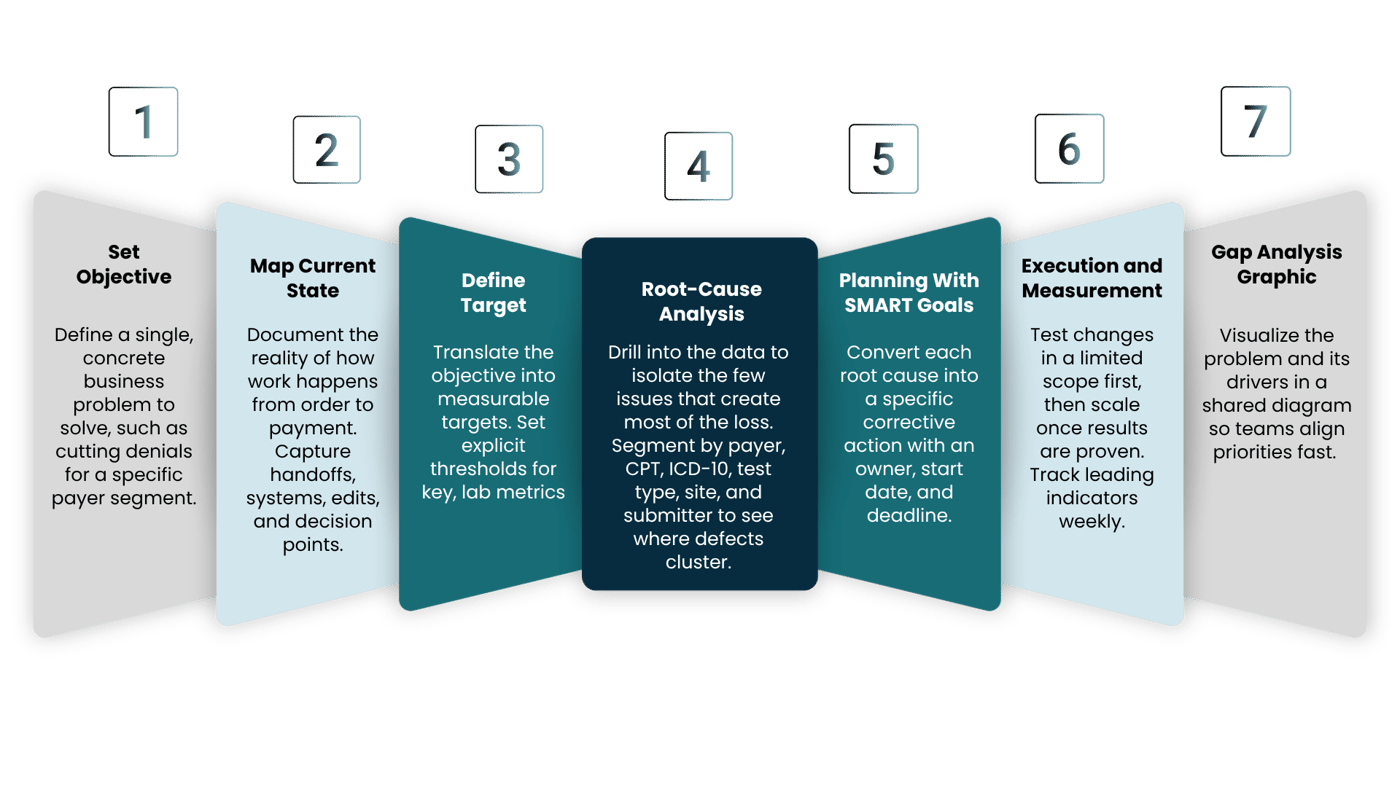
7 Steps to a Successful Gap Analysis

Gap Analysis Graphic
TELCOR_one
Set Objective

Define a single, concrete business problem to solve, such as cutting denials for a specific payer segment or reducing days in AR for molecular claims. Write the objective so it is clear, financially meaningful, and time bound, and get leadership agreement before moving on.


TELCOR_two
Map Current State

Document how work actually happens from order to payment, not how you think it happens. Capture handoffs, systems, edits, and decision points across intake, LIS, billing, clearinghouse, and payer touchpoints. Pull baseline metrics for denial categories, first pass clean claim rate, days in AR, and write-off patterns so you can quantify gaps later.

TELCOR_three
Define Target

Translate the objective into measurable targets that reflect financial impact. Set explicit thresholds for metrics such as first pass clean claim rate, denial rate by root cause, or AR aging distribution by payer. Align targets with budget, staffing, and technology constraints so they are aggressive yet achievable. 

TC_4
Root-Cause Analysis

Drill into the data to isolate the few issues that create most of the loss. Segment by payer, CPT, ICD-10, test type, site, and submitter to see where defects cluster. Validate hypotheses with chart reviews, workflow observations, and claim tracing so you separate symptoms from true causes.

TC_5
Action Planning Using SMART Goals

Convert each root cause into a specific corrective action with an owner, start date, and deadline. Define how success will be measured, how data will be captured, and what policy, form, or system change is required. Include change management items such as training, quick reference guides, and audit criteria so adoption sticks.

TC_6
Execution and Measurement

Pilot changes in a limited scope first, then scale once results are proven. Track leading indicators weekly, such as eligibility pass rates or clean claim yield, and track lagging indicators monthly, such as denial reductions and cash acceleration. Review progress with leadership on a fixed cadence and remove roadblocks quickly.

TC_7
Gap Analysis Graphic

Visualize the problem and its drivers so teams align priorities fast. Use a fishbone diagram to group causes under categories like People, Process, Technology, Data, and Payer Policy, then link each branch to a corrective action. Refresh the graphic as you learn and keep it visible in meetings, so focus does not drift. 

The Benefits of an RCM Gap Analysis

Icon-ClinicalLabs
Revenue Protection

Identifying and addressing the root causes of denials reduces unnecessary write-offs and preserves margins. 

Icon-VendorNeutrality
Cash Flow Optimization

Cleaner claims and streamlined workflows shorten days in accounts receivable and reduce reliance on credit lines. 

Icon-Service-1
Compliance Assurance

A detailed review of coding, documentation, and billing practices helps labs avoid penalties and payer recoupments. 

Icon-RealtimeAccess
Strategic Leverage 

Reliable data supports stronger payer negotiations and informed investments in automation and staffing. 

How a TELCOR Gap Analysis Performs

A mid-sized pathology group was processing 100,000 claims per month.

They Struggled With:
  • 18% of claims required manual rework before payment.

  • Commercial payer denials continued to increase month after month.

  • More than $2.3M sat in aging accounts receivable.

  • Leadership lacked visibility into the biggest revenue leaks.

Gap Analysis Recommended:
  • Automating front-end claim validation and edits.

  • Prioritizing denials based on financial impact.
  • Applying AI to repetitive revenue cycle tasks.
  • Establishing KPI dashboards for continuous optimization.
The Results:
  • Denials decreased by 30%, reducing costly rework and write-offs.
  • First-pass claim acceptance increased by 25%, accelerating reimbursement.
  • Net revenue grew by 15% within six months through cleaner claims.
  • Leadership gained more predictable cash flow and greater financial visibility.

Frequently asked questions

What is an RCM gap analysis for laboratories?
What data is needed for a lab RCM gap analysis? 
What are the 4 steps of gap analysis? 
Can ChatGPT do a gap analysis? 
How can a gap analysis help reduce lab denials? 
What happens after an RCM gap analysis? 
What should labs look for in an RCM partner? 

Resources to Help You Reach For More

Explore white papers, guides, and insights designed to support your revenue cycle management success.

CTA-doctor

Questions about gaps in your revenue cycle?

Let’s talk about how TELCOR can improve your workflows and strengthen your results.